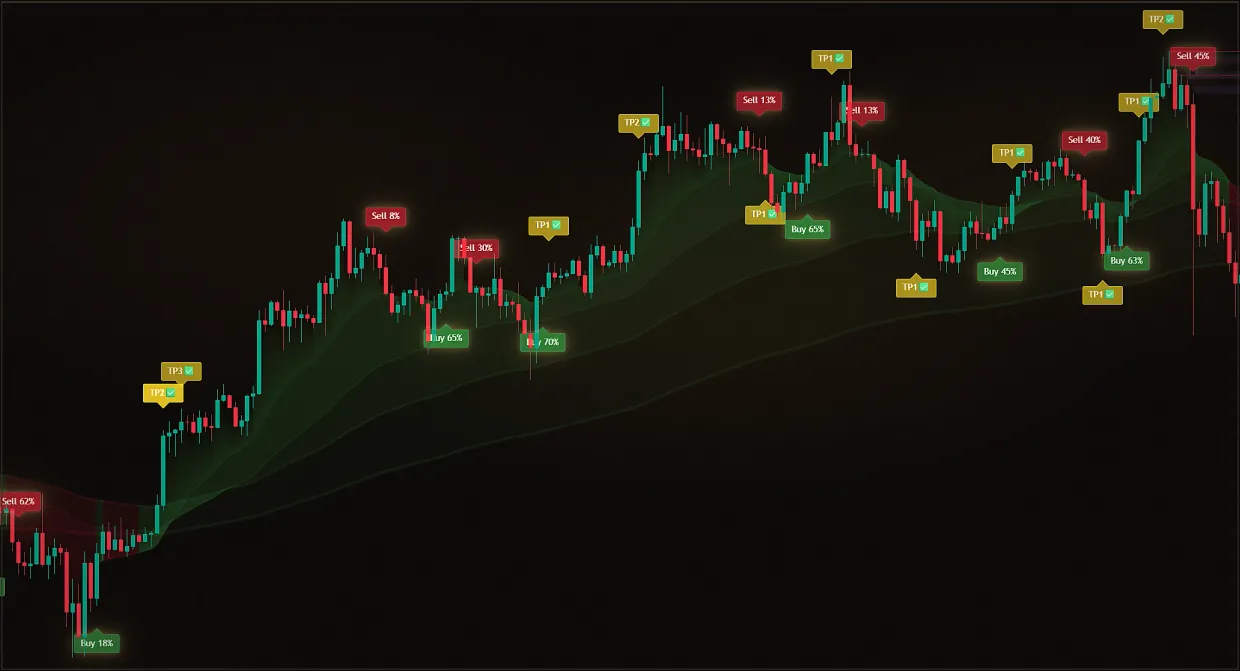
An oscillator answers the question 'how much has price accelerated,' not 'where will it go.' Formulas vary, but the principle is the same: the indicator compares the current price with prices over a selected period and converts the result into a number within a fixed range. Hence the name: the value oscillates between boundaries rather than moving indefinitely.
Typically, an oscillator has two zones at the edges of the range. Entering the upper zone is called overbought, and the lower one is called oversold. Many interpret this as "time to sell" and "time to buy," and it is precisely here that they lose money: in a strong movement, the oscillator can stay at the boundary for weeks while the price continues to move in the same direction.
Oscillators work reliably where the market moves in a range: the price bounces between levels, and the indicator neatly marks the edges. In a trend, they give many false signals. Therefore, an oscillator is almost never used alone — its readings are cross-checked with market structure, levels, and volume. The practical conclusion is simple: an oscillator is a measuring instrument, not a trading signal.